The slate
You are running an experiment every time you fish, with a dozen variables and no record of any of them. A twelve-dollar dive slate fixes that, and on a long shore session it may also be the thing that gets you home.
Why not just use your phone
Because you won't.
That is the whole argument, and every angler who has tried to keep a phone log knows it. The gap between a tool that works and a tool you actually use is where all the value sits.
A slate takes two seconds and one hand. No unlocking, no app, no wiping salt off a screen to see what you are typing. You can write on it with wet hands, with cold hands, in gloves, in rain, in full sun with no glare, and at night by headlamp. Drop it in the wash and pick it up again.
A phone asks you to stop fishing. You have to dry a hand, unlock, find the app, type against autocorrect, and put it away — and the whole time you are not watching your water. Most people do it twice, decide it is not worth it, and go back to remembering.
Then there is battery. Your phone is your emergency communication and your map. Spending its charge on logging is spending your margin on bookkeeping. A slate has no battery and a pencil does not fail in the cold.
The last reason is the most important one. Memory does not record — it reconstructs. Ask yourself what the current was doing during your best session last spring and you will produce an answer, confidently, and it will be partly invented. You will remember the fish and lose every variable that produced it. Write it down at the time or you do not have it.
The older reason to carry one
Everything above is practical. There is another reason, and for a lot of us it is the real one.
Shore fishing is one of the last ordinary activities that can be completely offline. Most of us carry the thing that ends that in a chest pocket anyway, and then find a reason to take it out.
A slate cannot do that to you. It does exactly one thing, and that constraint is the feature. Pull out a phone to log a tide stage and you are four seconds from an email, a notification, a photo you meant to send. The beach is gone and you are still standing on it. A slate takes the last legitimate excuse away — log on the slate and the phone can stay sealed in the pack where it belongs, for emergencies and nothing else.
Then there is what you are actually doing when you write on it.
The oldest surviving human records are notches cut into bone, tens of thousands of years old — older than writing, older than agriculture. What they were counting is still argued over. But somebody sat down with a sharp edge and a hard surface and kept track of something that mattered to them, because their memory alone was not good enough and they knew it.
You are doing the same thing, with the same motion, for the same reason. Scratching marks into a surface to hold what you observed. It is a very old instinct and it is satisfying in a way that typing into a form is not.
There is a practical edge to it too. Recording by hand forces you to actually look. You cannot write down what the current is doing without watching it for a few seconds first, and that observation is worth more than the note. Handwriting also seems to hold in memory better than typing does — you tend to remember the sessions you wrote out.
And a slate lets you draw, which a form field never will. Sketch the beach. Mark where the trough runs, where the rip sets up on the ebb, where the bottom changes, where the hit came from. Thirty seconds of bad drawing holds spatial information that no amount of text captures, and spatial knowledge of a beach is exactly the thing you are trying to build.
None of this is nostalgia. It just happens that the simplest tool is also the one that keeps you present, and being present is most of what catching fish from shore actually requires.
The one I own
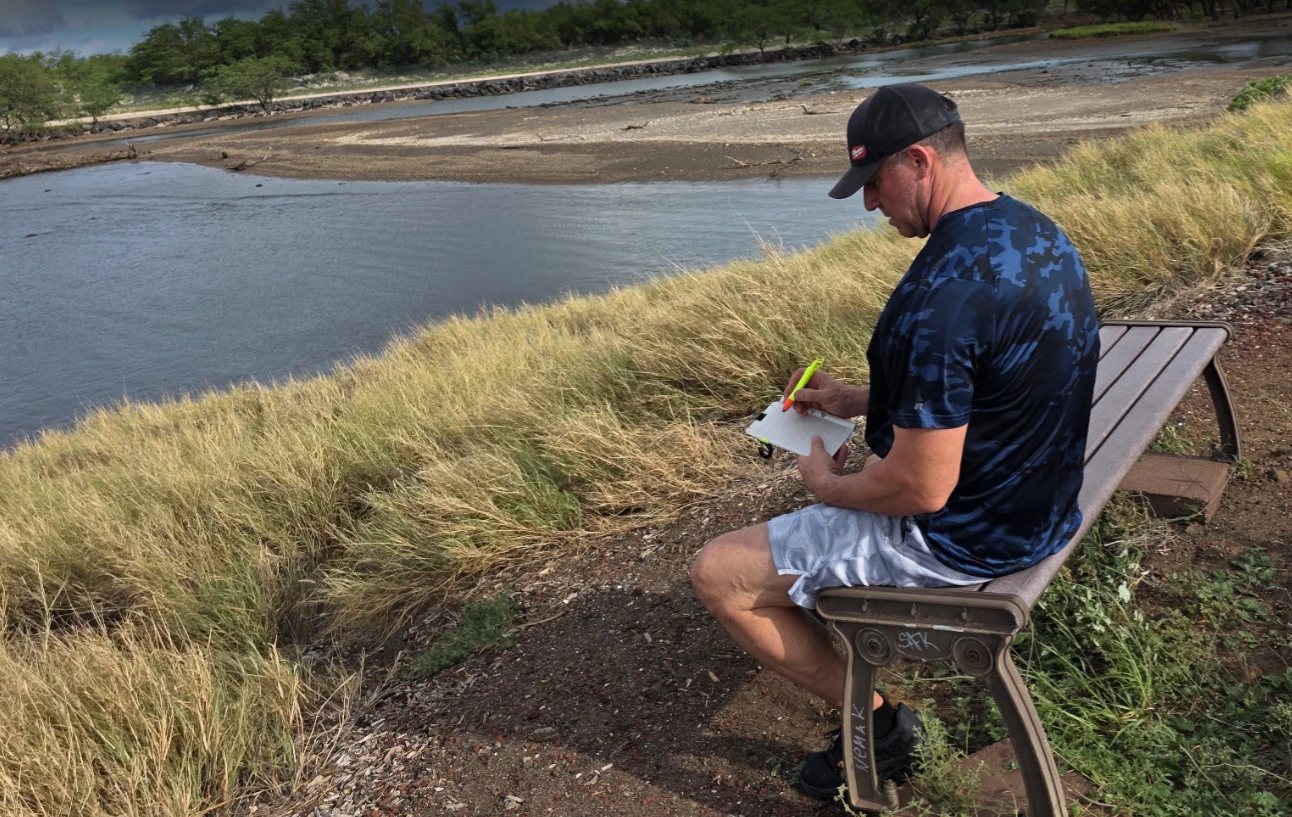
The slate in the photos is an Innovative Scuba Concepts 5 x 7 with the Super Pencil, about seventeen dollars at any dive shop. It has been in the jacuzzi, the pool and the salt, and none of them have marked it. It does not leave home without me: between sessions it lives in the truck, for anything that needs writing down when there is no technology to hand, and that turns out to be often.
Grade: 9/10. It is one of the items on the register that carry the veteran status, gear that earned its place before the register existed, and the one that has never had a day off. The rest are on Reviews.
What to record while the water is in front of you
The apps already give you tide tables and wind forecasts. What no app has is what your beach actually looked like at 0530 on a Tuesday. That is the only data that is yours, and it is the data that goes stale the instant you walk away.
Tide stage, not tide height. Direction matters more than level. Two hours after high on a falling tide fishes nothing like two hours after low on a rising one, even when the water sits at the same mark. Write the stage and how long into it you are.
Current direction and strength. This is the variable most anglers never write down and it is frequently the one actually driving the day. Current does not always follow the tide — wind, swell angle and bottom shape all push it around. You do not need instruments: note which way your line sweeps and how hard. "Left to right, strong enough to belly the line in ten seconds" is a real measurement.
Wind relative to the beach, not the compass. Onshore, offshore, or cross, and roughly how hard. A compass bearing means nothing when you re-read it in eight months; "hard onshore, quartering from the left" tells you instantly what the water was doing. Onshore stacks bait against the shore and stirs the column. Offshore flattens and clears it.
Water clarity and color. Visibility in feet if you can judge it, and the color — green, brown, blue, milky. This is what decides lure color and whether sight-feeding fish can even find your offering.
Water temperature, if you carry a thermometer. Degrees move fish far more reliably than calendar dates do. A season of logged temperatures will tell you when your runs actually start, rather than when they are supposed to.
Bird activity. Species, height, and behavior — diving, sitting, milling, or absent. Absent is data too.
Clock time of every strike, follow and landing. Not "around dawn." The actual time. Across a season these cluster, and the clusters rarely land where you assume they do.
Reading what is already on the beach
Two sources of information are sitting there free before you make a cast, and almost nobody writes either one down.
The wrack line is a census
Everything dead on the sand came from the water you are about to fish. The strand line is a sample of the system, delivered to you, and it is the single most underused data source in shore fishing.
What to note:
- Dead or dying baitfish — species and rough size. This tells you what the forage base is right now, which tells you what to throw. Fresh and intact means recent; picked over and dried means days old.
- Crab molts. A wrack line full of shed shells means crabs are molting, which means soft-shell crabs are in the water, which means predators are keyed on them. That is directly actionable, and it is a window that closes.
- Squid, salps, jellies. Salps and jellies arriving in numbers usually mean a water mass has moved in — often clean, often cold. Squid mean squid, and whatever is eating them.
- Offshore species where they should not be. Anything pelagic or deepwater on a beach means something unusual happened out there. Wind shift, upwelling, a current edge moving inshore.
- Volume and freshness. A heavy fresh wrack line after a blow means the water column got turned over. An empty, scoured beach means something else entirely.
- Die-offs. Numbers of one species, all dead, is a warning — algal bloom, oxygen crash, temperature shock. Note it, and consider fishing somewhere else.
Over a season, wrack notes turn into a calendar of what arrives when at your particular beach. No app publishes that.
Other anglers are expiring intelligence
Write down how many are out, where they are standing, what they are throwing, and what they are catching. Then write down what they are not catching, which is usually the more informative half.
A few things worth capturing:
- Where people are not standing. A stretch that is always empty on a crowded morning is empty for a reason somebody learned the hard way.
- An unusually empty spot. If the regulars are absent from a place they normally work, something changed — access, conditions, or the fish.
- What the old hands do with the tide. The angler who has fished that beach every morning for twenty years knows more about it than any forecast. Note when he arrives and when he leaves. That is his tide window, learned over decades, and he is giving it to you for free.
This intelligence expires. You will not remember in November what the crowd was doing in June unless it is on the slate.
The data that gets you home
Everything above makes you a better angler. This part is why the slate is a safety item.
If you are three miles out, you have three miles back. That is obvious written down and almost impossible to hold onto while fishing, because a good bite dismantles your judgment. Every extra mile you walk toward feeding fish costs two, and you pay the second one tired, in the dark, against a tide that has come in behind you.
Tick your distance
Mark each mile or kilometer on the slate as you pass it. Not a rough sense of how far you have gone — an actual tally you made a mark for.
This works where a watch does not, and not because watches are inaccurate. A physical tick is a decision. You have to stop, acknowledge the number, and choose to add another one. That half second of friction is the entire point, and it is what stops the drift from two miles into five without ever having decided to go five.
Write the turnaround before you start
At the top of the slate, before you leave the truck, write two numbers: the furthest you will go, and the time you turn around regardless.
Set them while you are rested, fed, and not looking at breaking fish. That version of you has better judgment than the one who will be standing there at mile four with birds working. The slate is a contract between them.
The turnaround time is the harder one to honor and the one that matters more. Distance you can usually recover from. Running out of light three miles from the truck on a falling shelf is a different category of problem.
Note the cut-offs
As you walk out, write down every feature that closes behind you on a rising tide — points, coves, rock shelves, anything you crossed at low water.
Write the time it closes, not just that it does. "Point closes 1540" is the kind of note that has saved people, and its absence is how shore anglers get cliffed out. If you cannot estimate the time, note the water mark you crossed it at and check it against the tide.
Light budget
Sunset time minus your walk home, minus a margin. Put the resulting number on the slate beside the turnaround time. Headlamps fail, and a beach you know well is a different beach in the dark.
Exit points
As you pass them, mark the places you can get off the beach before the truck — trails, stairs, road access, a parking area. When something goes wrong, the question is not how far back the truck is. It is how far to the nearest way out, and you will not reconstruct that list under pressure.
Two lines that cost nothing
Before you leave, write on the slate who you told and when you said you would be back. It sounds like paperwork. It is the difference between somebody starting to look for you at dark and somebody starting to look for you tomorrow.
If you also carry water and food figures — what you started with, what you have drunk — you will know your margin without digging through the pack.
Making it compound
One slate is a note. Fifty are a pattern.
The habit that turns the first into the second is transcription. When you get home, photograph the slate or copy it into a spreadsheet, then wipe it clean for next time. A slate you never transcribe is a to-do list, not a dataset — and the wiping is not optional, because a crowded slate stops getting written on.
After a season you can sort by any column and ask questions nobody can answer for you. What tide stage produced your fish. Whether the onshore days really were better or you just remember them that way. Whether the run starts at a date or at a temperature. Which mile of beach actually earns the walk.
The apps give you the general case — general tide, general wind, general forecast. What they cannot give you is your beach, your rod, your window. Nobody is collecting that but you.
Where the slate lives
First line. It is flat, it weighs nothing, and it belongs in a pocket or on a lanyard rather than in a bag you might set down.
The slate is not the failure point — the pencil is. Graphite writes wet and ink does not, so carry a pencil stub on a leash and keep a spare in second line. That is the one-level separation rule applied to the cheapest item you own, and it is a good habit to practice on something that costs a dollar.
The turnaround time and the cut-off times are the only entries on the slate that are not optional. Everything else makes you better at fishing. Those two get you off the beach.
The gear this note is about
Straight from the register: the slots this note covers, where each stands, and under most of them the highest-rated options as rated by other people. Nothing listed as a candidate has been carried; the ones in testing have.
- Dive slate VeteranInnovative Scuba Concepts 5 x 7 with the Super Pencil, owned for years and graded 9/10. Flat plastic, on a clip or in a pocket. Turnaround, cut-offs, distance ticks, conditionsThe one owned, and the highest rated elsewhere
- Innovative Scuba Concepts Underwater Slate with Super Pencil 5 x 7 Veteran · 9/10 Requested 27 Sep 2026 The one owned: jacuzzi, pool and salt water, and it lives in the truck between trips. Flat plastic, tethered pencil, sized for a sling pocket · about $17 rated here Jacuzzi, pool and salt water, and it lives in the truck between trips
- JCS (JC Scuba) Dive Slate 3.5 x 5.5 with Pencil and Lanyard Pocket-size plastic slate, pencil and lanyard pre-attached, US-made, under $5 · about $5 rated here
- Innovative Scuba Concepts Quest Underwater Erasable Slate Requested 27 Sep 2026 Magnetic write-and-erase screen, conventional slate on the back, no pencil needed · about $45 rated here
- Pencil stub, on a leash CandidateGraphite writes wet; ink does notHighest rated elsewhere, not yet carried
- Rite in the Rain Mechanical Clicker Pencil YE13 1.3 mm 2B lead, brass knurled grip, writes on wet paper · about $10 rated here
- Rite in the Rain Weatherproof Mini Slide-Click Mechanical Pencil (3-pack) Pocket-length 0.9 mm pencil with oversized clip; leash-friendly stub · about $26 rated here
- Rite in the Rain All-Weather Carpenter Pencil No. 59-12 Cheap wood HB stub; break it short, tie it off, no mechanism to fail · about $15 rated here
- Spare pencil CandidateThe one-level rule on the cheapest thing you ownHighest rated elsewhere, not yet carried
- Rite in the Rain No. 13 Mechanical Clicker Pencil, 1.3 mm Metal body, glove-friendly clicker, thick lead writes on wet paper · about $10 rated here
- Scale and tape TestingSmall spring scale, soft tape. The numbers that go on the slate. In testing, owned: a KastKing ToughTide digital hanging scale, 2.86 oz on the scale. Whether a charge lasts a trip, to comeHighest rated elsewhere, not yet carried
- Rapala 25 lb Mechanical Scale No batteries; stainless spring and hook; built-in 32-inch tape; $20 · about $20 rated here
- Eastaboga Tackle BogaGrip 315 (15 lb) Requested 25 Sep 2026 Stainless spring scale plus lip grip; survives salt immersion; Field & Stream pick · about $150 rated here
- FishRule 36-inch Fish Measuring Tape Soft roll-up tape, inches and cm; fits a shirt pocket · about $13 rated here