Leave it better
The walk out, the pack is full and heavy. Water is most of that weight — a liter is a kilogram, and a long day on hot sand is three or four liters. By the turnaround you have drunk most of it, and what you are carrying now is empty space.
That space has a job. The beach is full of things that should not be on it, and the person walking back along it with a light pack and a free hand is the one person positioned to do something about that. So the rule on this site is simple: the walk back is the cleanup. Leave every beach better than you found it, by the amount of pack you emptied getting there.
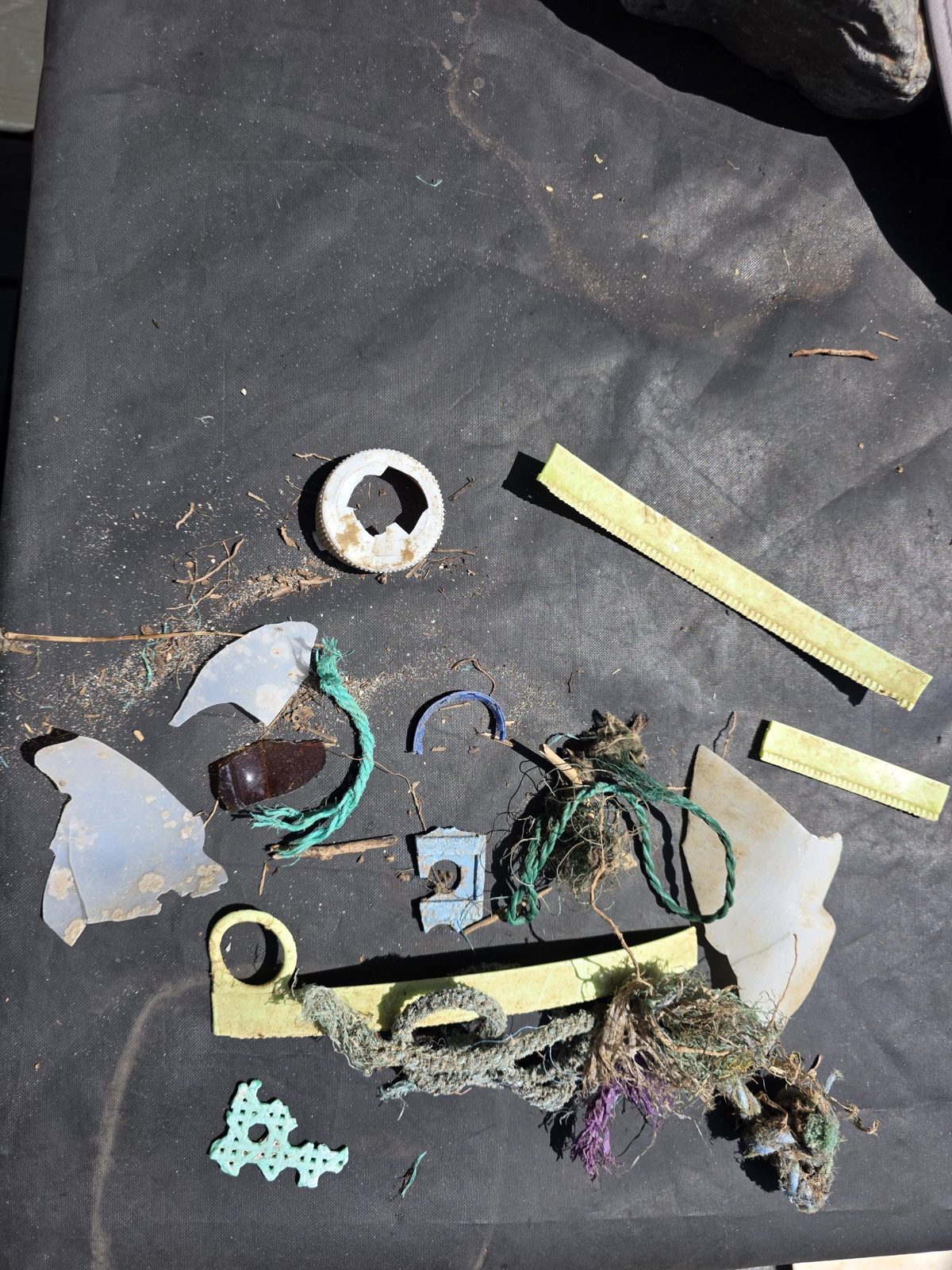
Why it is ours to do
Not out of virtue. Out of self-interest, and because most of what is on the sand is ours.
Walk any fished beach at low water and look at the wrack line. Monofilament in birds' nests. Braid that will outlast the beach. Hooks in the weed, sinkers in the rock, lure packaging, bait bags, the rings off soft-plastic packets. Some of it blew out of a boat, some of it was dropped, most of it was cut off and left because the angler was looking at the water.
And it is what gets fishing access withdrawn. Beach access for anglers gets taken away because of anglers: a hook in a child's foot, line round a lifeguard's propeller, a family beach that looks like a tackle shop floor. One person's bad morning becomes a bylaw, and the bylaw outlives everyone involved. Every foot of line you carry out is a small argument for the next angler still being allowed on that sand.
There is a quieter reason too. A beach you have cleaned is a beach you have read. You cannot pick line out of the wrack without seeing what else the wrack holds — what died, what molted, what the water brought in — and that is the census you were supposed to be taking anyway.
What to pick up
In order, because the first three are the ones that hurt people and animals:
- Line. Every length of mono, fluoro and braid you can reach. Wind it round your hand as you go so it does not tangle everything else in the bag.
- Hooks, lures and rigs. Anything with a point. Into the hardest container you have; a bait box or a zip bag inside a zip bag. Nothing with a hook goes loose in a pack.
- Sinkers. Lead is lead. They are also free, and you will use them.
- Packaging. Bait bags, lure blisters, the plastic rings off soft-plastic packs, snack wrappers, bottle caps. This is the bulk of it and it weighs nothing.
- Bottles and cans, if there is room after the above. There usually is.
What to leave: anything medical, anything that looks like it came off a vessel and might be reported, anything too heavy to carry safely to the exit, and anything alive. Note the big stuff on the slate with a rough position and pass it to whoever manages the beach. A rope coil or a fuel drum is their job, not a solo walk-out's.
How it packs
The trash bag lives in third line, where the water was. That is not an accident: as the bladder empties the bag fills, and the pack stays roughly the same shape all day. A single heavy-duty zip bag holds a surprising amount of line, and a compactor bag folded flat is the reserve for a beach that turns out to be bad.
Keep the sharp things separate from the soft things, and keep both separate from your own gear. A treble hook that migrates through a wrapper into your rain shell is the kind of thing that turns a good deed into a first-aid stop.
Wear the sun gloves for it. Fishing line at the wrack line has been in the sun for months and it cuts, and half of what is wrapped in it has a point.
At the exit
Sort it at the truck, not on the beach. Line and hooks go to a tackle shop with a recycling tube if there is one, and there increasingly is; the rest goes in the bin. Rinse the bag, stuff it back in third line, and it is ready for tomorrow.
Then two numbers on the slate, next to the fish: what you carried out, and roughly how much of it was line. Over a season that is a record nobody else is keeping, and it tells you which beaches are being fished hard and which are being fished badly.
The honest version
None of this is about being seen doing it, and you will mostly not be. It is about the fact that the mobile angler is the only person who walks the whole beach, every time, with a pack that empties as the day goes on. That is a design feature. Use it.
You are borrowing the beach from whoever fishes it after you. Give it back with less on it than it had.
The gear this note is about
Straight from the register: the slots this note covers, where each stands, and under most of them the highest-rated options as rated by other people. Nothing listed as a candidate has been carried; the ones in testing have.
- Zip bags and a trash bag CandidateLives where the water was. As the bladder empties the bag fills: line, hooks, wrappers, on the walk backHighest rated elsewhere, not yet carried
- Ziploc Slider Power Shield Freezer Bags TechGearLab Editors' Choice; thickest film, best in squeeze tests · about $20 rated here
- Ziploc Grip 'N Seal Freezer Bags Double zipper with grip tabs; opens with wet or cold hands · about $21 rated here
- Hefty Slider Freezer Bags Cheaper slider freezer bag in the same test; fine for line scraps · about $13 rated here
- Hydration bladder Testing2 to 3 L, in the pack, hose to the shoulder strap. In testing, owned: the 2.5 L HydraPak reservoir that rides in the Osprey Siskin 8 (the day pack), about 3 oz with its hose and magnetic bite valve. It is the water on the Cabo legThe one owned, and the highest rated elsewhere
- HydraPak 2.5 L reservoir Veteran · grade to come Requested 23 Sep 2026 Rides in the day pack with its hose and magnetic bite valve, about 3 oz with the hose. The water on the Cabo leg
- Osprey Hydraulics Reservoir 3L In Testing Rigid backplate loads easily into a full pack, quick-disconnect hose, magnetic clip. In testing · about $50 rated here
- HydraPak Contour 3L Requested 23 Sep 2026 CleverHiker best overall; reversible for drying, bite-valve shutoff, 5.5 oz · about $49 rated here
- CamelBak Crux 3L Reservoir CleverHiker best value; big handle for filling, no plastic taste, easy-find parts · about $40 rated here
- The day pack TestingThe second line is named after it. In testing, owned: Osprey Siskin 8 with its 2.5 L HydraPak reservoir and hose, 21.83 oz assembled against a listed 18.6 oz bare, so the reservoir and tube are about 3 oz. Mesh back panel, magnetic bite valveIn testing, and the highest rated elsewhere
- BASSDASH FV08 Ultra Lightweight Fishing Vest, chest pack In Testing Vest-style chest pack, one size, with front pouches either side. The third way to carry the second line, against the Osprey Siskin and the Blowbak sling: whether it carries the fighting load and stays out of the way of a two-handed cast. Measured: 12.64 oz (358 g), empty, on the hanging scale (0.79 lb)
- KastKing Blowbak Fishing Sling Bag In Testing Sling with a rod holder, MOLLE webbing, water-resistant material; the sling against the day pack. The rod holder on a long walk, and whether it stays put mid-cast. Measured: 26.88 oz (762 g), empty, on the hanging scale (1.68 lb)